In a recent publication in Nucleic Acids Research, Laski, Brümmer, Lucic, and colleagues demonstrate that miRNAs from the miR-17 and let-7 families can compete for mRNA target sites involving a non-canonical miRNA-target interaction.
miRNAs are generally known to recognize and bind target sites complementary to six- to eight-nucleotides located at the 5′ end of the miRNA sequence, known as the miRNA seed sequence. While the seed sequences of miR-17 and let-7 families differ, suggesting distinct target sites for both, six nucleotides at the 3′ end of miR-17 sequences are identical to the let-7 seed sequence.
Through rigorous experiments by scientists at the ETH in Zurich and extensive bioinformatics data analyses, performed by Anneke Brümmer from the UNIL-EPFL Bioinformatics Competence Center (BICC) of FBM, the team demonstrated a competition for the same target sites between canonical let-7 seed-mediated binding and non-canonical 3’ end-directed target interaction by miR-17. As opposed to canonical targeting, which leads to target mRNA destabilization, non-canonical interaction by miR-17 did not affect target mRNA abundance. Instead, miR-17 competition shields let-7 target sites preventing let-7 from binding and destabilizing its target mRNAs.
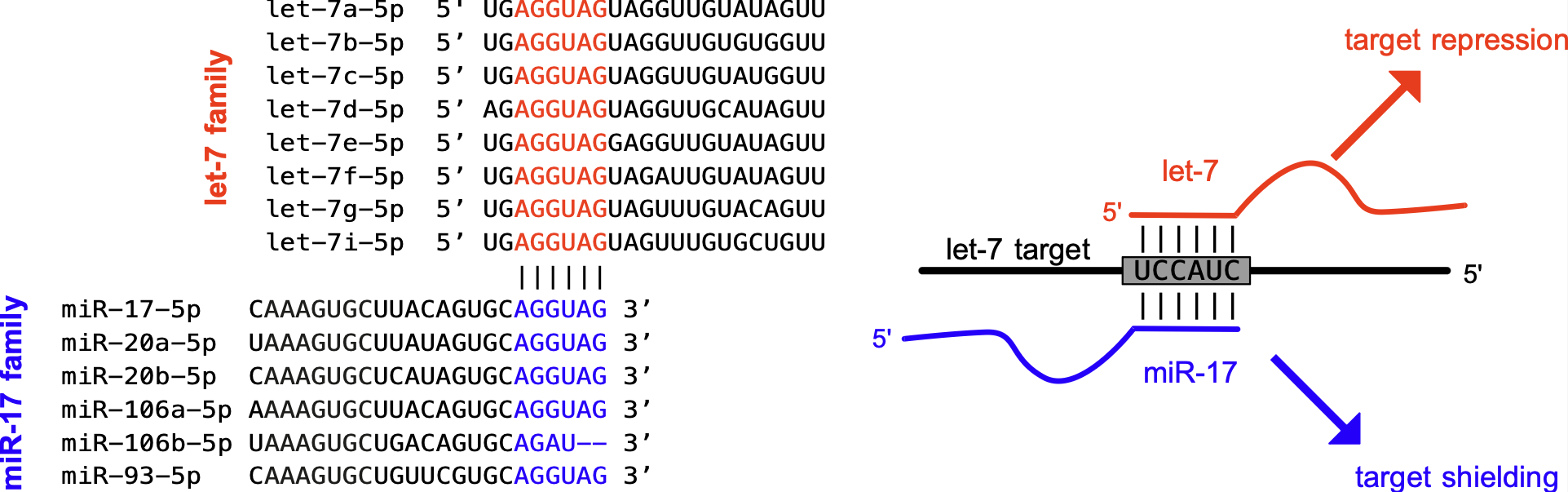
This form of competition between miRNAs may represent a previously unrecognized mechanism of miRNA-mediated gene regulation. Moreover, a broader screen of miRNA sequences revealed numerous similarities between miRNA 5’ seed sequences and the 3′ end sequences of other miRNAs, suggesting that such interactions may be widespread. However, further experimental validation will be required to confirm the functional relevance for each.
The original paper :
Artur Laski, Anneke Brümmer, Matije Lucic, Elisa Federici, Iris Mestres-Pascual, Jochen Imig, Alexander Kanitz, Mihaela Zavolan, Luca F R Gebert, Ian J MacRae, Carlo V Catapano, Jonathan Hall.S
Seedless 3′ pairing enables miR-17 family miRNAs to seize let-7 target sites.
Nucleic Acids Research, Volume 54, Issue 15, 27 August 2026, gkag767
https://doi.org/10.1093/nar/gkag767